Friday, April 30, 2026, the Abingdon and Galax Workforce Centers will be closed.
Please be sure and contact your local Workforce Center before venturing out to ensure they are open and operating,

Friday, April 30, 2026, the Abingdon and Galax Workforce Centers will be closed.
Please be sure and contact your local Workforce Center before venturing out to ensure they are open and operating,
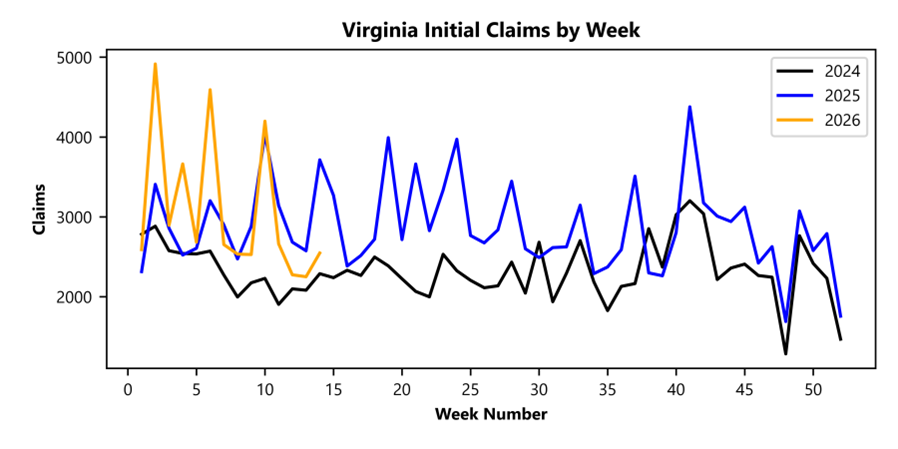
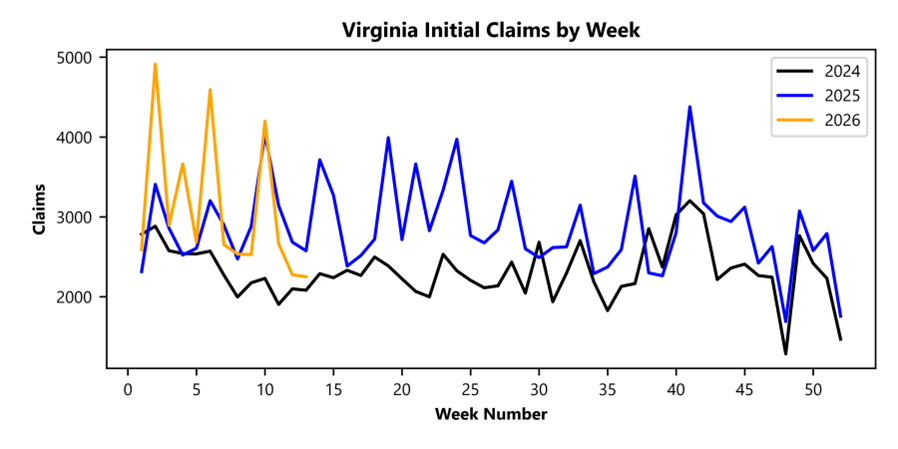
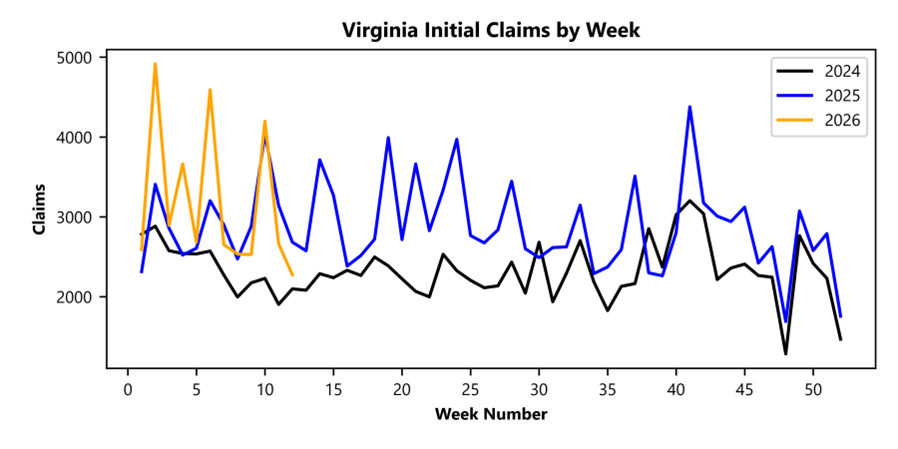
RICHMOND— Virginia Works’ Economic Information and Analytics Division, which serves as the Commonwealth’s official source for labor market and workforce data, reported that that 2,547 unemployment insurance weekly initial claims were filed during the week ending April 04, 2026. The claims were filed with the Virginia Employment Commission, which administers the Commonwealth’s Unemployment Insurance program. This is 13.2 percent higher than last week’s 2,250 claims and 31.4 percent lower than the comparable week of last year (3,714). Nearly 83 percent of claimants self-reported an employer which correlates to an associated industry. Based on this reporting, the top five industries (60 percent) were Professional, Scientific, and Technical Services (385); Administrative and Support and Waste Management (248); Health Care and Social Assistance (225); Retail Trade (200); and Manufacturing (199).
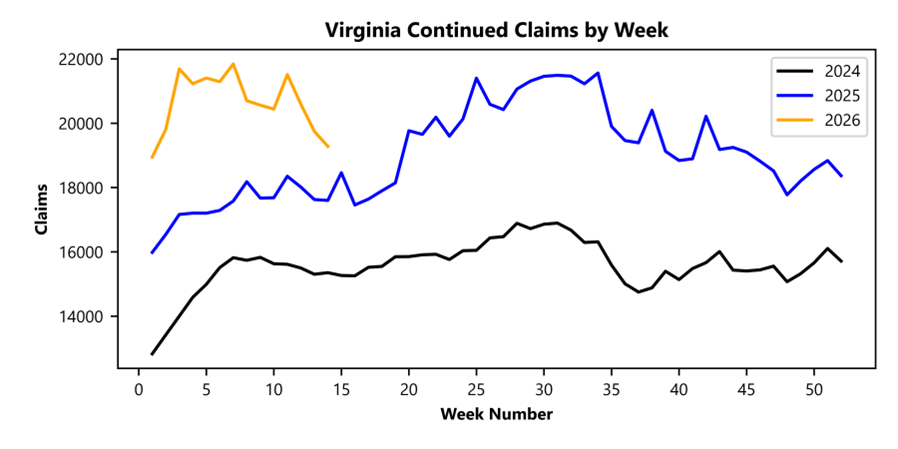
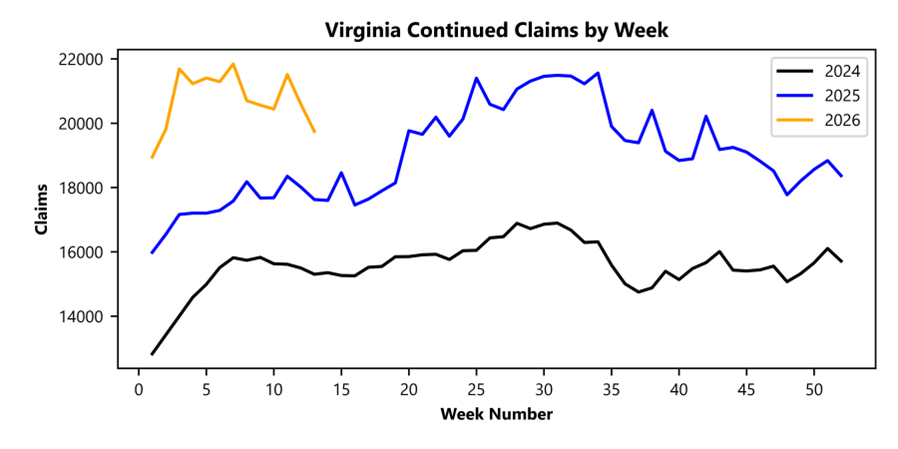
Continued weeks’ claims (19,280) were 2.4 percent lower than last week (19,745) and were 9.6 percent higher than the comparable week of last year (17,598). Nearly 92 percent of claimants self-reported an employer which correlates to an associated industry. Based on this reporting, the top five industries (59 percent) were Professional, Scientific, and Technical Services (3,791); Administrative and Support and Waste Management (2,218); Health Care and Social Assistance (1,746); Retail Trade (1,423); and Manufacturing (1,341).
Significant Layoffs and Announcements are available at the following websites:
Announcements | Virginia Economic Development Partnership
|
Unemployment Claims Activity Comparison |
||||
|
|
Week
Ending |
Week
Ending |
Week
Ending |
Last
Year |
|
Initial Claims |
2,547 |
2,250 |
2,274 |
3,714 |
|
Initial Change (%) |
+297 (+13.2%) |
-24 (-1.1%) |
-388 (-14.6%) |
-1,167 (-31.4%) |
|
Continued Claims |
19,280 |
19,745 |
20,592 |
17,598 |
|
Continued Change (%) |
-465 (-2.4%) |
-847 (-4.1%) |
-919 (-4.3%) |
+1,682 (+9.6%) |
Virginia Continued Weeks Claimed as a Percentage of Total Workforce
A person who has already filed an initial claim and who has experienced a week of unemployment files a continued claim to claim benefits for that week of unemployment. On a weekly basis, continued claims reflect a good approximation of the current number of insured unemployed workers filing for UI benefits, and are a good indicator of labor market conditions. While continued claims are not a leading indicator, they provide confirming evidence of the direction of the economy.
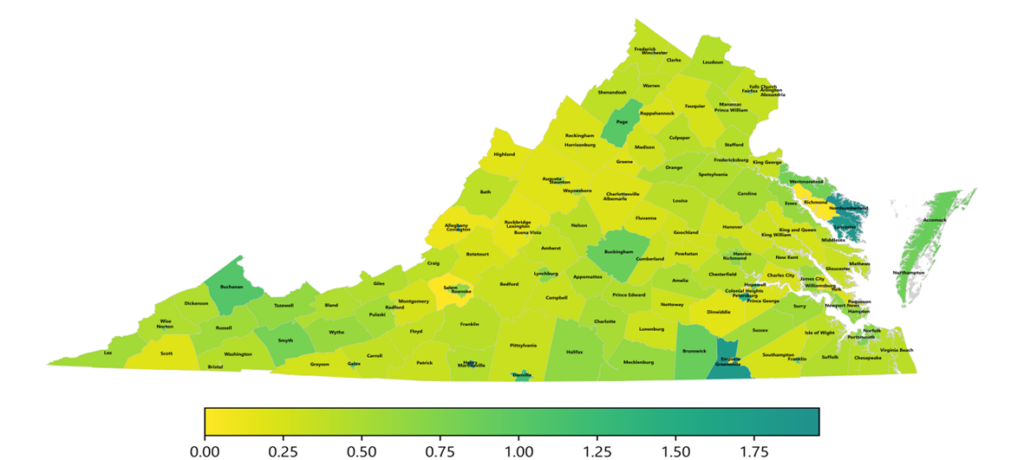
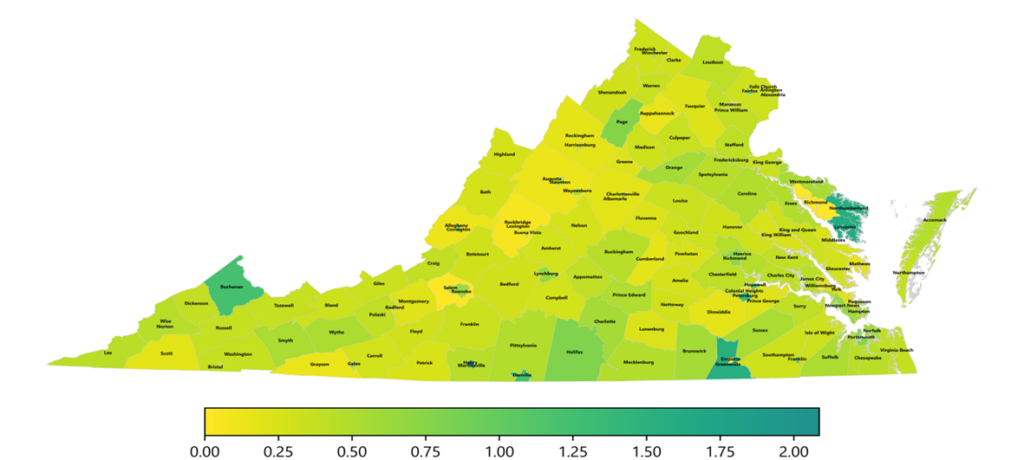
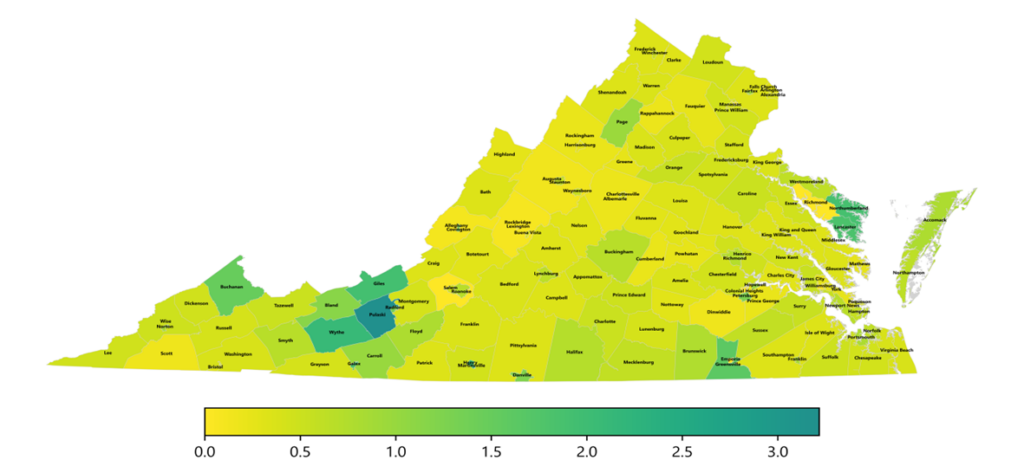
The color-coded map below shows the distribution of this week’s continued claims in Virginia’s counties and cities, expressed as a percentage of each locality’s labor force. This approach provides a more meaningful comparison across areas by adjusting for differences in labor force size. Yellow represents a lower percentage of continued claims relative to the labor force, while progressively darker shades transitioning from yellow to green and dark green indicate higher percentages. The legend at the bottom shows the color spectrum and its corresponding percentage ranges.
RICHMOND— Virginia Works’ Economic Information and Analytics Division, which serves as the Commonwealth’s official source for labor market and workforce data, reported that that 2,250 unemployment insurance weekly initial claims were filed during the week ending March 28, 2026. The claims were filed with the Virginia Employment Commission, which administers the Commonwealth’s Unemployment Insurance program. This is 1.1 percent lower than last week’s 2,274 claims and 12.6 percent lower than the comparable week of last year (2,575). Nearly 82 percent of claimants self-reported an employer which correlates to an associated industry. Based on this reporting, the top five industries (64 percent) were Professional, Scientific, and Technical Services (282); Administrative and Support and Waste Management (230); Manufacturing (223); Health Care and Social Assistance (221); and Retail Trade (206).
Continued weeks’ claims (19,745) were 4.1 percent lower than last week (20,592) and were 12.0 percent higher than the comparable week of last year (17,625). Nearly 92 percent of claimants self-reported an employer which correlates to an associated industry. Based on this reporting, the top five industries (59 percent) were Professional, Scientific, and Technical Services (3,928); Administrative and Support and Waste Management (2,254); Health Care and Social Assistance (1,730); Retail Trade (1,448); and Manufacturing (1,339).
Significant Layoffs and Announcements are available at the following websites:
Announcements | Virginia Economic Development Partnership
|
Unemployment Claims Activity Comparison |
||||
|
|
Week
Ending |
Week
Ending |
Week
Ending |
Last
Year |
|
Initial Claims |
2,250 |
2,274 |
2,662 |
2,575 |
|
Initial Change (%) |
-24 (-1.1%) |
-388 (-14.6%) |
-1,536 (-36.6%) |
-325 (-12.6%) |
|
Continued Claims |
19,745 |
20,592 |
21,511 |
17,625 |
|
Continued Change (%) |
-847 (-4.1%) |
-919 (-4.3%) |
+1,074 (+5.3%) |
+2,120 (+12.0%) |
Virginia Continued Weeks Claimed as a Percentage of Total Workforce
A person who has already filed an initial claim and who has experienced a week of unemployment files a continued claim to claim benefits for that week of unemployment. On a weekly basis, continued claims reflect a good approximation of the current number of insured unemployed workers filing for UI benefits, and are a good indicator of labor market conditions. While continued claims are not a leading indicator, they provide confirming evidence of the direction of the economy.
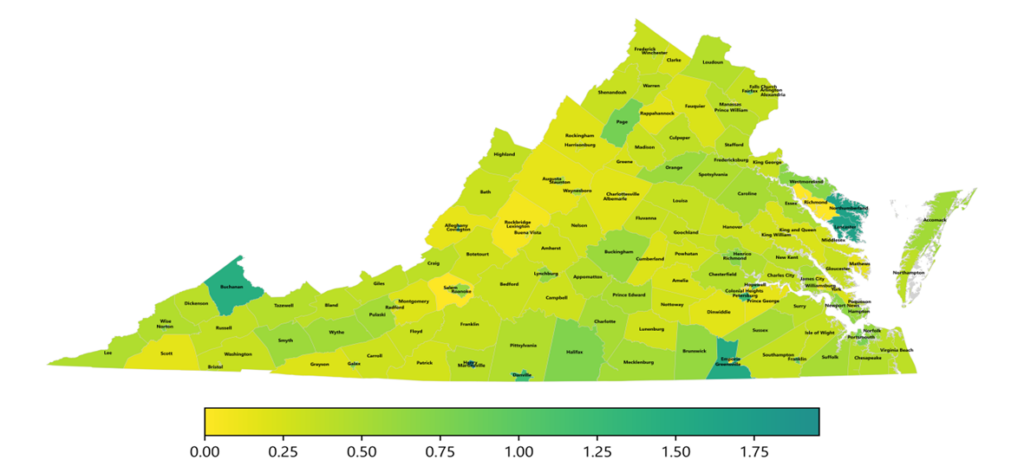
The color-coded map below shows the distribution of this week’s continued claims in Virginia’s counties and cities, expressed as a percentage of each locality’s labor force. This approach provides a more meaningful comparison across areas by adjusting for differences in labor force size. Yellow represents a lower percentage of continued claims relative to the labor force, while progressively darker shades transitioning from yellow to green and dark green indicate higher percentages. The legend at the bottom shows the color spectrum and its corresponding percentage ranges.
RICHMOND— Virginia Works’ Economic Information and Analytics Division, which serves as the Commonwealth’s official source for labor market and workforce data, reported that that 2,274 unemployment insurance weekly initial claims were filed during the week ending March 21, 2026. The claims were filed with the Virginia Employment Commission, which administers the Commonwealth’s Unemployment Insurance program. This is 14.6 percent lower than last week’s 2,662 claims and 15.2 percent lower than the comparable week of last year (2,683). Nearly 78 percent of claimants self-reported an employer which correlates to an associated industry. Based on this reporting, the top five industries (58 percent) were Professional, Scientific, and Technical Services (276); Administrative and Support and Waste Management (196); Health Care and Social Assistance (188); Retail Trade (167); and Manufacturing (153).
Continued weeks’ claims (20,592) were 4.3 percent lower than last week (21,511) and were 14.3 percent higher than the comparable week of last year (18,013). Nearly 92 percent of claimants self-reported an employer which correlates to an associated industry. Based on this reporting, the top five industries (59 percent) were Professional, Scientific, and Technical Services (3,935); Administrative and Support and Waste Management (2,284); Manufacturing (1,852); Health Care and Social Assistance (1,739); and Retail Trade (1,468).
Significant Layoffs and Announcements are available at the following websites:
Announcements | Virginia Economic Development Partnership
|
Unemployment Claims Activity Comparison |
||||
|
|
Week
Ending |
Week
Ending |
Week
Ending |
Last
Year |
|
Initial Claims |
2,274 |
2,662 |
4,198 |
2,683 |
|
Initial Change (%) |
-388 (-14.6%) |
-1,536 (-36.6%) |
+1,670 (+66.1%) |
-409 (-15.2%) |
|
Continued Claims |
20,592 |
21,511 |
20,437 |
18,013 |
|
Continued Change (%) |
-919 (-4.3%) |
+1,074 (+5.3%) |
-123 (-0.6%) |
+2,579 (+14.3%) |
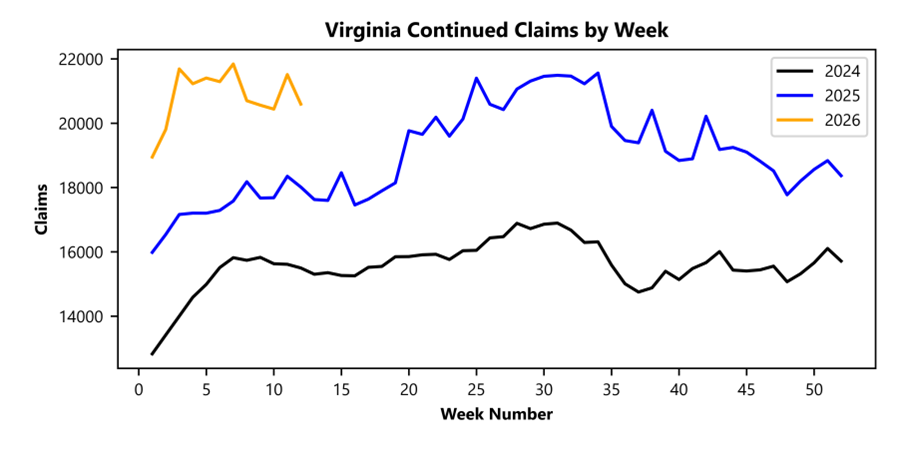
Virginia Continued Weeks Claimed as a Percentage of Total Workforce
A person who has already filed an initial claim and who has experienced a week of unemployment files a continued claim to claim benefits for that week of unemployment. On a weekly basis, continued claims reflect a good approximation of the current number of insured unemployed workers filing for UI benefits, and are a good indicator of labor market conditions. While continued claims are not a leading indicator, they provide confirming evidence of the direction of the economy.
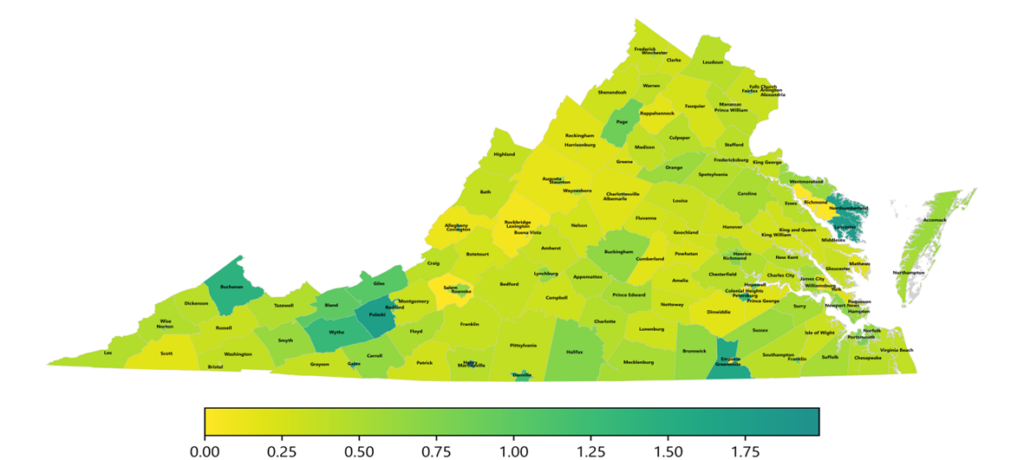
The color-coded map below shows the distribution of this week’s continued claims in Virginia’s counties and cities, expressed as a percentage of each locality’s labor force. This approach provides a more meaningful comparison across areas by adjusting for differences in labor force size. Yellow represents a lower percentage of continued claims relative to the labor force, while progressively darker shades transitioning from yellow to green and dark green indicate higher percentages. The legend at the bottom shows the color spectrum and its corresponding percentage ranges.
Grow with Google is now offering an AI Professional Certificate for free to those signed up with Coursera.
Coursera Link and more information on the program on Google’s Site
Visit the VirginiaHasJobs AI website for more information
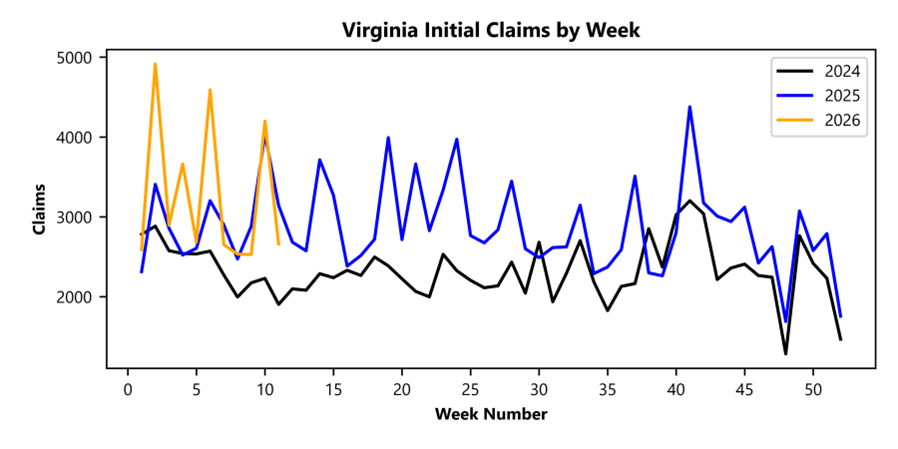
RICHMOND— Virginia Works’ Economic Information and Analytics Division, which serves as the Commonwealth’s official source for labor market and workforce data, reported that that 2,662 unemployment insurance weekly initial claims were filed during the week ending March 14, 2026. The claims were filed with the Virginia Employment Commission, which administers the Commonwealth’s Unemployment Insurance program. This is 36.6 percent lower than last week’s 4,198 claims and 15.2 percent lower than the comparable week of last year (3,141). Nearly 80 percent of claimants self-reported an employer which correlates to an associated industry. Based on this reporting, the top five industries (62 percent) were Professional, Scientific, and Technical Services (344); Manufacturing (297); Health Care and Social Assistance (237); Administrative and Support and Waste Management (210); and Retail Trade (185).
Continued weeks’ claims (21,511) were 5.3 percent higher than last week (20,437) and were 17.2 percent higher than the comparable week of last year (18,349). Nearly 92 percent of claimants self-reported an employer which correlates to an associated industry. Based on this reporting, the top five industries (60 percent) were Professional, Scientific, and Technical Services (3,954); Administrative and Support and Waste Management (2,390); Manufacturing (2,340); Health Care and Social Assistance (1,646); and Construction (1,510).
Significant Layoffs and Announcements are available at the following websites:
Announcements | Virginia Economic Development Partnership
|
Unemployment Claims Activity Comparison |
||||
|
|
Week
Ending |
Week
Ending |
Week
Ending |
Last
Year |
|
Initial Claims |
2,662 |
4,198 |
2,528 |
3,141 |
|
Initial Change (%) |
-1,536 (-36.6%) |
+1,670 (+66.1%) |
-5 (-0.2%) |
-479 (-15.2%) |
|
Continued Claims |
21,511 |
20,437 |
20,560 |
18,349 |
|
Continued Change (%) |
+1,074 (+5.3%) |
-123 (-0.6%) |
-138 (-0.7%) |
+3,162 (+17.2%) |
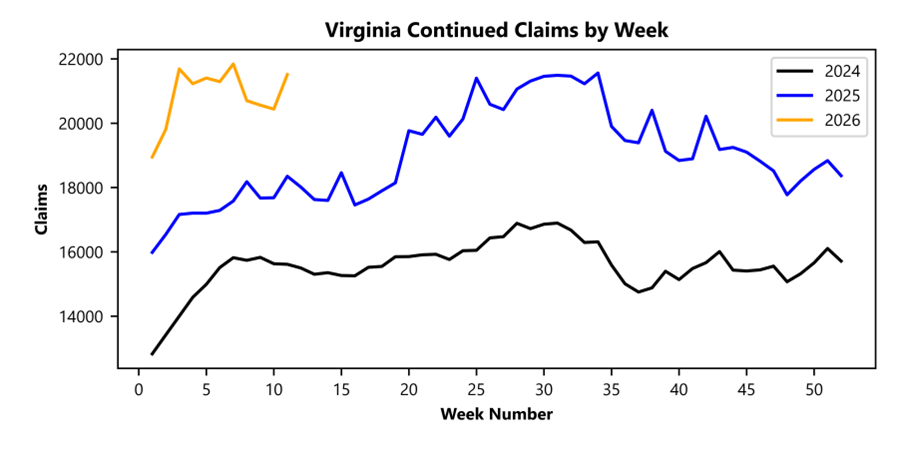
Virginia Continued Weeks Claimed as a Percentage of Total Workforce
A person who has already filed an initial claim and who has experienced a week of unemployment files a continued claim to claim benefits for that week of unemployment. On a weekly basis, continued claims reflect a good approximation of the current number of insured unemployed workers filing for UI benefits, and are a good indicator of labor market conditions. While continued claims are not a leading indicator, they provide confirming evidence of the direction of the economy.
The color-coded map below shows the distribution of this week’s continued claims in Virginia’s counties and cities, expressed as a percentage of each locality’s labor force. This approach provides a more meaningful comparison across areas by adjusting for differences in labor force size. Yellow represents a lower percentage of continued claims relative to the labor force, while progressively darker shades transitioning from yellow to green and dark green indicate higher percentages. The legend at the bottom shows the color spectrum and its corresponding percentage ranges.
Richmond, VA – Governor Abigail Spanberger’s office has announced key leadership appointments at Virginia Works, the Commonwealth’s Department of Workforce Development and Advancement. Commissioner Nicole Overley has been reappointed to lead the agency, joined by two senior officials: Nicholas Toth as Deputy Commissioner for Policy and Strategy and Dana Westgren as Senior Policy Advisor.
“I am grateful for the Governor’s confidence and am honored to continue serving the Commonwealth,” said Commissioner Overley. “In addition, Nicholas Toth and Dana Westgren bring exceptional experience in workforce development and public service. Their leadership will support our mission to strengthen Virginia’s talent pipeline and expand opportunities for workers and employers across the Commonwealth.”
Secretary of Labor Jessica Looman underscored the significance of the appointments. “These leaders bring substantial experience in workforce development at the state and national levels,” said Secretary Looman. “Their combined expertise will support Virginia Works as it advances innovative strategies that improve access to high‑quality careers for Virginians and help our employers meet essential talent needs.”
Nicholas Toth, Deputy Commissioner for Policy and Strategy, is a career-long public servant with extensive experience in state and federal workforce policy. He most recently served as Advisor to the New Jersey Labor Commissioner, providing strategic guidance on statewide workforce development, economic policy, and enforcement initiatives. His prior roles include Deputy Assistant Commissioner for New Jersey’s Division of Workforce Development and founding State Director of the New Jersey Office of Apprenticeship, where he oversaw substantial expansion of apprenticeship opportunities. At the federal level, he served as Special Assistant to the U.S. Secretary of Labor and as a Policy Advisor in the Office of the Assistant Secretary for Policy. Toth holds both a Bachelor and Master’s degree from Cornell University and a Master in Public Policy from Princeton University.
Dana Westgren, Senior Policy Advisor, brings ten years of workforce policy experience across federal, nonprofit, and state-focused organizations. Most recently, she served at the Corporation for a Skilled Workforce, supporting national workforce initiatives. Her prior service at the U.S. Department of Labor’s Employment and Training Administration included data and policy leadership within the Workforce Innovation and Opportunity Act (WIOA) program office and serving as Unit Chief for WIOA governance. Westgren specializes in using outcomes data to inform policy and expand access to high‑quality employment opportunities, particularly for underserved populations. She previously worked at the National Governors Association and as a Job Developer with Academy of Hope in Washington, DC. She holds a Bachelor of Science in Management and Marketing from the University of Illinois Urbana‑Champaign and a Master of Public Administration from the Cornell Brooks School of Public Policy.
Nicole Overley has served as Commissioner of Virginia Works since September 2024. Under her leadership, Virginia Works has delivered measurable results for the Commonwealth while building the infrastructure for long-term impact. In 2025, Virginia Works placed over 20,000 Virginians into jobs, supported more than 3,500 returning citizens with career coaching, and earned Virginia the #1 national ranking in active programs and employer sponsors among state apprenticeship agencies, all while implementing internal process modernizations, technology enhancements, and talent development initiatives that have built a high-performing, responsive agency ready to serve Virginians at every point in their workforce journeys. Commissioner Overley joined Virginia Works with more than a decade of experience at Deloitte Consulting, where she established and scaled the firm’s Future of Work practice for government, higher education, and nonprofits and was named to Consulting Magazine’s “35 under 35” and was given Deloitte’s “Good, Good, Good” award for responsible leadership and public sector impact. She holds two degrees from Johns Hopkins University, and her combination of private-sector innovation and public-sector expertise continues to guide Virginia Works’ approach: workforce strategy grounded in execution, and outcomes grounded in people.
Virginia Works, the Commonwealth’s Department of Workforce Development and Advancement, is dedicated to serving both job seekers and employers with a wide range of workforce services and talent strategies. Virginia Works is an equal opportunity employer. Auxiliary aids and services are available upon request to individuals with disabilities. VRC/TDD VA Relay 711.
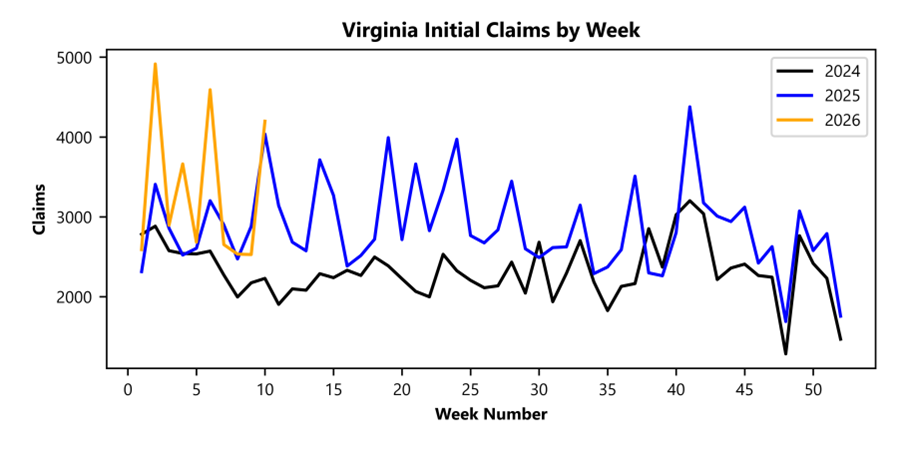
RICHMOND— Virginia Works’ Economic Information and Analytics Division, which serves as the Commonwealth’s official source for labor market and workforce data, reported that that 4,198 unemployment insurance weekly initial claims were filed during the week ending March 07, 2026. The claims were filed with the Virginia Employment Commission, which administers the Commonwealth’s Unemployment Insurance program. This is 66.1 percent higher than last week’s 2,528 claims and 4.0 percent higher than the comparable week of last year (4,036). Nearly 77 percent of claimants self-reported an employer which correlates to an associated industry. Based on this reporting, the top five industries (73 percent) were Manufacturing (1,258); Professional, Scientific, and Technical Services (369); Administrative and Support and Waste Management (244); Retail Trade (226); and Health Care and Social Assistance (197).
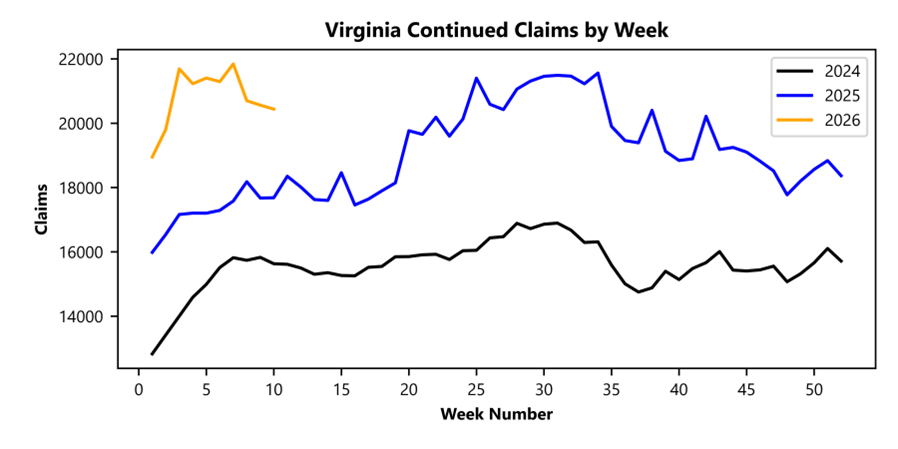
Continued weeks’ claims (20,437) were 0.6 percent lower than last week (20,560) and were 15.6 percent higher than the comparable week of last year (17,681). Nearly 92 percent of claimants self-reported an employer which correlates to an associated industry. Based on this reporting, the top five industries (59 percent) were Professional, Scientific, and Technical Services (3,978); Administrative and Support and Waste Management (2,443); Health Care and Social Assistance (1,689); Construction (1,611); and Retail Trade (1,457).
Significant Layoffs and Announcements are available at the following websites:
Announcements | Virginia Economic Development Partnership
|
Unemployment Claims Activity Comparison |
||||
|
|
Week
Ending |
Week
Ending |
Week
Ending |
Last
Year |
|
Initial Claims |
4,198 |
2,528 |
2,533 |
4,036 |
|
Initial Change (%) |
+1,670 (+66.1%) |
-5 (-0.2%) |
-120 (-4.5%) |
+162 (+4.0%) |
|
Continued Claims |
20,437 |
20,560 |
20,698 |
17,681 |
|
Continued Change (%) |
-123 (-0.6%) |
-138 (-0.7%) |
-1,143 (-5.2%) |
+2,756 (+15.6%) |
Virginia Continued Weeks Claimed as a Percentage of Total Workforce
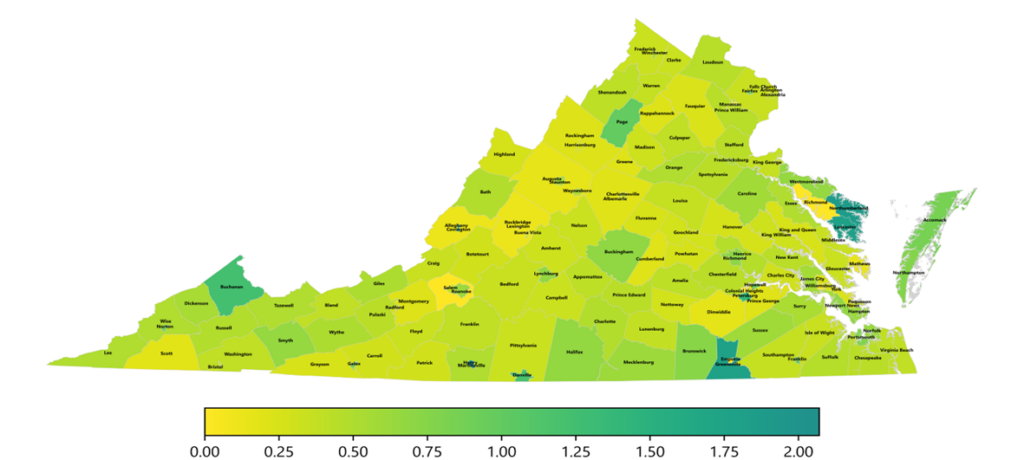
A person who has already filed an initial claim and who has experienced a week of unemployment files a continued claim to claim benefits for that week of unemployment. On a weekly basis, continued claims reflect a good approximation of the current number of insured unemployed workers filing for UI benefits, and are a good indicator of labor market conditions. While continued claims are not a leading indicator, they provide confirming evidence of the direction of the economy.
The color-coded map below shows the distribution of this week’s continued claims in Virginia’s counties and cities, expressed as a percentage of each locality’s labor force. This approach provides a more meaningful comparison across areas by adjusting for differences in labor force size. Yellow represents a lower percentage of continued claims relative to the labor force, while progressively darker shades transitioning from yellow to green and dark green indicate higher percentages. The legend at the bottom shows the color spectrum and its corresponding percentage ranges.
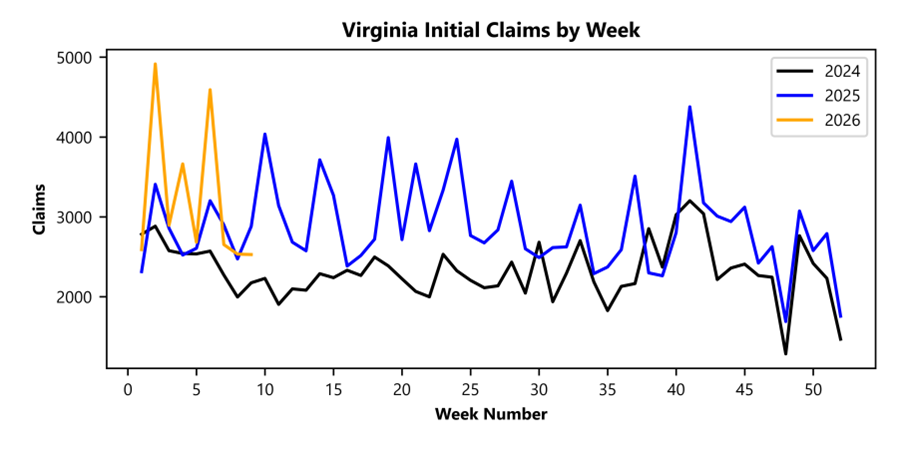
RICHMOND— Virginia Works’ Economic Information and Analytics Division, which serves as the Commonwealth’s official source for labor market and workforce data, reported that that 2,528 unemployment insurance weekly initial claims were filed during the week ending February 28, 2026. The claims were filed with the Virginia Employment Commission, which administers the Commonwealth’s Unemployment Insurance program. This is 0.2 percent lower than last week’s 2,533 claims and 12.3 percent lower than the comparable week of last year (2,881). Nearly 82 percent of claimants self-reported an employer which correlates to an associated industry. Based on this reporting, the top five industries (56 percent) were Professional, Scientific, and Technical Services (328); Health Care and Social Assistance (233); Administrative and Support and Waste Management (203); Retail Trade (183); and Manufacturing (158).
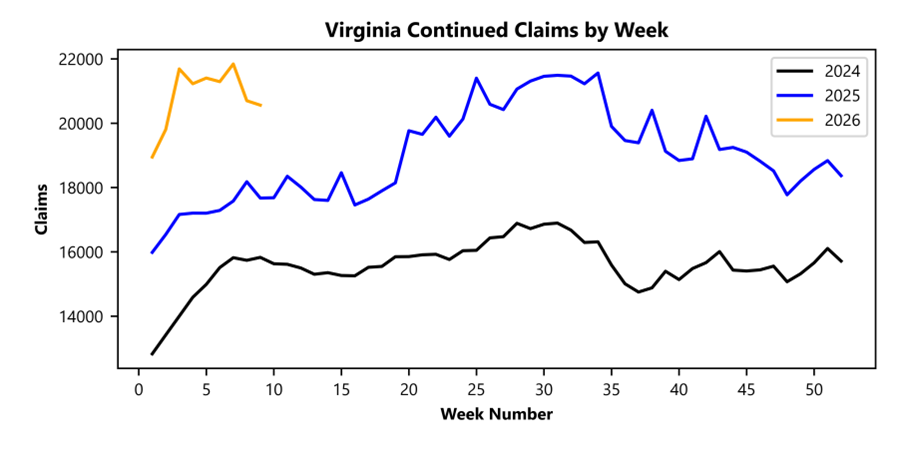
Continued weeks’ claims (20,560) were 0.7 percent lower than last week (20,698) and were 16.3 percent higher than the comparable week of last year (17,671). Nearly 92 percent of claimants self-reported an employer which correlates to an associated industry. Based on this reporting, the top five industries (60 percent) were Professional, Scientific, and Technical Services (4,003); Administrative and Support and Waste Management (2,484); Construction (1,709); Health Care and Social Assistance (1,681); and Retail Trade (1,468).
Significant Layoffs and Announcements are available at the following websites:
Announcements | Virginia Economic Development Partnership
|
Unemployment Claims Activity Comparison |
||||
|
|
Week
Ending |
Week
Ending |
Week
Ending |
Last
Year |
|
Initial Claims |
2,528 |
2,533 |
2,653 |
2,881 |
|
Initial Change (%) |
-5 (-0.2%) |
-120 (-4.5%) |
-1,939 (-42.2%) |
-353 (-12.3%) |
|
Continued Claims |
20,560 |
20,698 |
21,841 |
17,671 |
|
Continued Change (%) |
-138 (-0.7%) |
-1,143 (-5.2%) |
+550 (+2.6%) |
+2,889 (+16.3%) |
Virginia Continued Weeks Claimed as a Percentage of Total Workforce
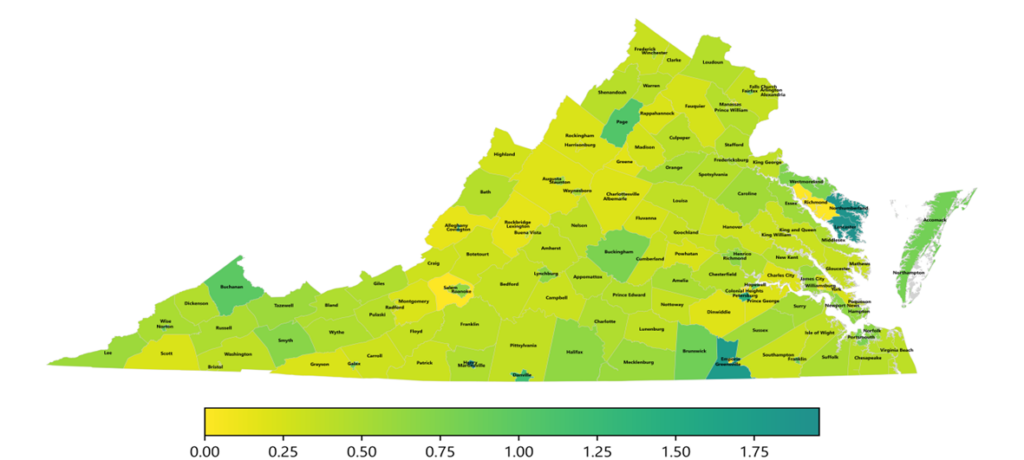
A person who has already filed an initial claim and who has experienced a week of unemployment files a continued claim to claim benefits for that week of unemployment. On a weekly basis, continued claims reflect a good approximation of the current number of insured unemployed workers filing for UI benefits, and are a good indicator of labor market conditions. While continued claims are not a leading indicator, they provide confirming evidence of the direction of the economy.
The color-coded map below shows the distribution of this week’s continued claims in Virginia’s counties and cities, expressed as a percentage of each locality’s labor force. This approach provides a more meaningful comparison across areas by adjusting for differences in labor force size. Yellow represents a lower percentage of continued claims relative to the labor force, while progressively darker shades transitioning from yellow to green and dark green indicate higher percentages. The legend at the bottom shows the color spectrum and its corresponding percentage ranges.
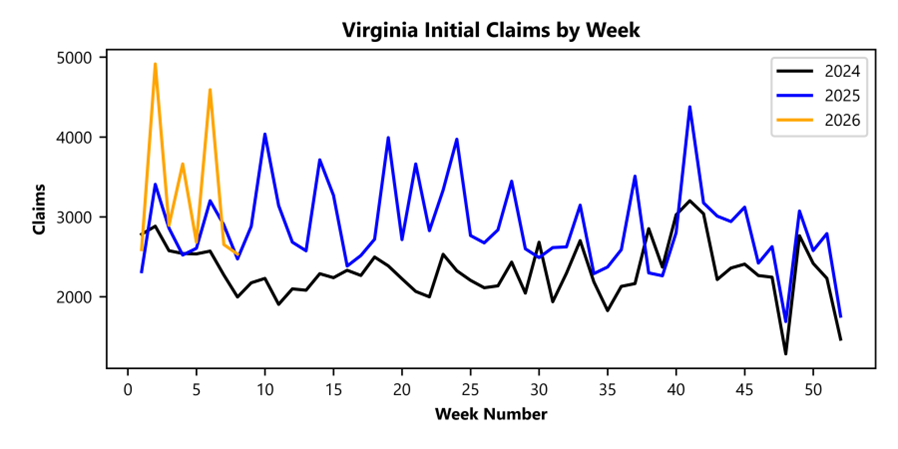
RICHMOND – Virginia Works’ Economic Information and Analytics Division, which serves as the Commonwealth’s official source for labor market and workforce data, reported that that 2,533 unemployment insurance weekly initial claims were filed during the week ending February 21, 2026. The claims were filed with the Virginia Employment Commission, which administers the Commonwealth’s Unemployment Insurance program. This is 4.5 percent lower than last week’s 2,653 claims and 2.4 percent higher than the comparable week of last year (2,473). Nearly 79 percent of claimants self-reported an employer which correlates to an associated industry.
Based on this reporting, the top five industries (57 percent) were Professional, Scientific, and Technical Services (307); Administrative and Support and Waste Management (222); Health Care and Social Assistance (205); Retail Trade (203); and Accommodation and Food Services (164).
Continued weeks’ claims (20,698) were 5.2 percent lower than last week (21,841) and were 13.9 percent higher than the comparable week of last year (18,179). Nearly 92 percent of claimants self-reported an employer which correlates to an associated industry.
Based on this reporting, the top five industries (60 percent) were Professional, Scientific, and Technical Services (4,079); Administrative and Support and Waste Management (2,501); Construction (1,725); Health Care and Social Assistance (1,692); and Retail Trade (1,454).
Significant Layoffs and Announcements are available at the following websites:
Announcements | Virginia Economic Development Partnership
|
Unemployment Claims Activity Comparison |
||||
|
|
Week
Ending |
Week
Ending |
Week
Ending |
Last
Year |
|
Initial Claims |
2,533 |
2,653 |
4,592 |
2,473 |
|
Initial Change (%) |
-120 (-4.5%) |
-1,939 (-42.2%) |
+1,909 (+71.2%) |
+60 (+2.4%) |
|
Continued Claims |
20,698 |
21,841 |
21,291 |
18,179 |
|
Continued Change (%) |
-1,143 (-5.2%) |
+550 (+2.6%) |
-112 (-0.5%) |
+2,519 (+13.9%) |
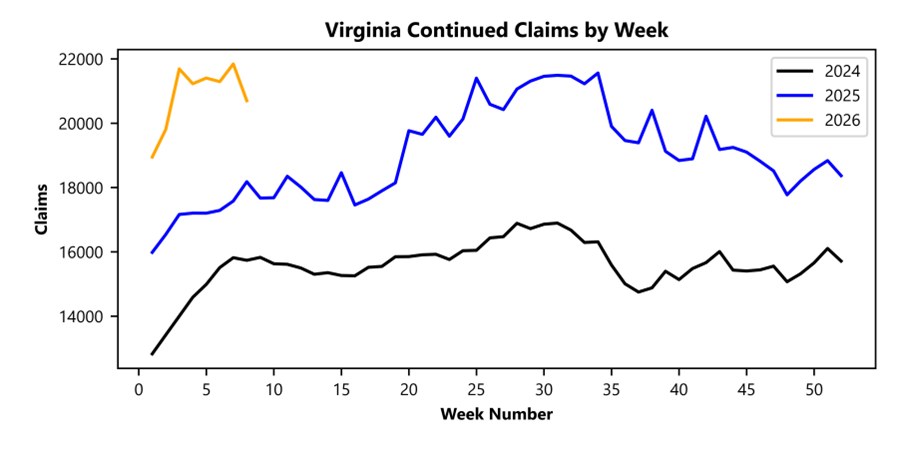
Virginia Continued Weeks Claimed as a Percentage of Total Workforce
A person who has already filed an initial claim and who has experienced a week of unemployment files a continued claim to claim benefits for that week of unemployment. On a weekly basis, continued claims reflect a good approximation of the current number of insured unemployed workers filing for UI benefits, and are a good indicator of labor market conditions. While continued claims are not a leading indicator, they provide confirming evidence of the direction of the economy.
The color-coded map below shows the distribution of this week’s continued claims in Virginia’s counties and cities, expressed as a percentage of each locality’s labor force. This approach provides a more meaningful comparison across areas by adjusting for differences in labor force size. Yellow represents a lower percentage of continued claims relative to the labor force, while progressively darker shades transitioning from yellow to green and dark green indicate higher percentages. The legend at the bottom shows the color spectrum and its corresponding percentage ranges.