
July 24, 2025
RICHMOND— Virginia Works (the Virginia Department of Workforce Development and Advancement) announced today that the U.S. Bureau of Labor Statistics’ May 2025 Job Openings and Labor Turnover Survey (JOLTS) reports an increase in job openings as well as an increase in job hires.
On the last business day in May, there were 251,000 job openings in Virginia, seasonally adjusted, an increase of 63,000 from April’s revised figure and one of the largest increases among states. Job openings were little changed from May 2024’s figure. Nationwide, the number of job openings was little changed at 7.8 million in May. U.S. job openings increased in accommodation and food services (314,000) and in finance and insurance (91,000). The number of job openings decreased in federal government (−39,000). The Virginia job openings rate rose to 5.5 percent. Nationwide, the job openings rate, at 4.6 percent, changed little over the month.
The number of hires in Virginia was 163,000 in May, up by 25,000 from April’s revised figure and more than double the low set in April 2020. JOLTS defines hires as all additions to the payroll during the month. In May, the number of U.S. hires was little changed at 5.5 million. In Virginia, the 3.8 percent hires rate was up over the month. The U.S. rate of hires nationwide was little changed at 3.4 percent. The number of hires decreased in federal government (-11,000).
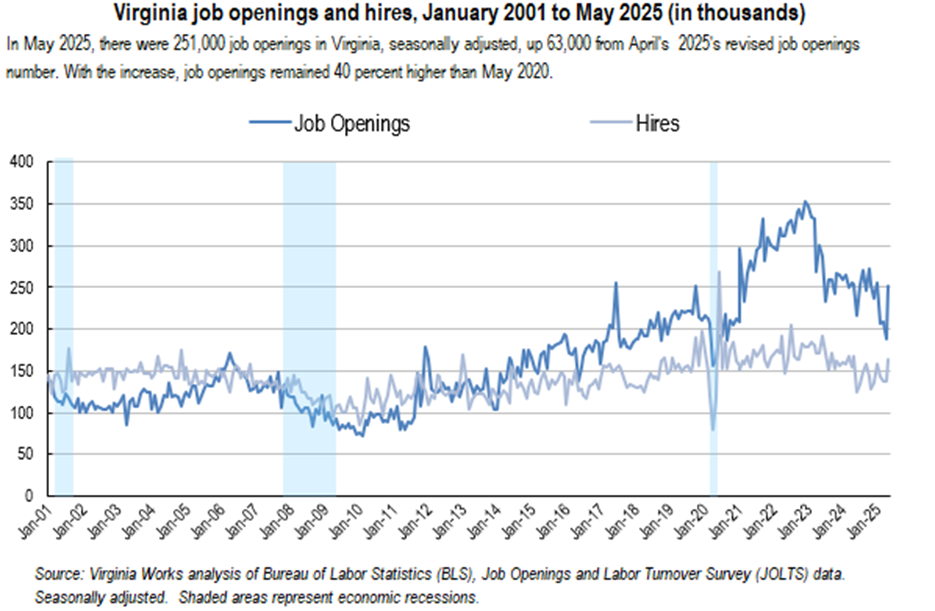
The Virginia hires-per-job-openings (HPJO) ratio was little changed at seven hires for every ten job openings, comparable to nationwide. This measure shows the rate of hiring compared to open jobs and is a proxy for time to fill positions. In May 2025, there were 0.6 unemployed per job opening in the Commonwealth, compared to one unemployed per job opening nationwide.
BLS’s JOLTS data provides information on all the components that make up the net change in the number of jobs over a month, including job openings, hires, layoffs, voluntary quits, and other job separations (including retirements and worker deaths). Together, these components attempt to reveal the overall change in payroll employment. JOLTS data is seasonally adjusted and describes conditions on the last business day of the month. The current month’s data is preliminary and the previous month’s data has been revised.
Total job separations in Virginia decreased by 2,000 to 145,000. Nationwide, the number of total separations in May was little changed at 5.2 million. Total separations significantly decreased in finance and insurance (-42,000). The Virginia total separations rate was unchanged at 3.4 percent. Nationwide, the total separations rate remained unchanged for the fifth month in a row at 3.3 percent.
An estimated 93,000 workers quit jobs (‘quits’) from Virginia employers in May, an increase of 23,000 over the month. Nationwide in May, the number of quits was little changed at 3.3 million. The quits rate in the Commonwealth rose to 2.2 percent. Over the month, the U.S. quits rate was little changed at 2.1 percent. The May ‘churn’ rate (the sum of the hires and total separations rates) in Virginia rebounded by 0.6 of a percentage
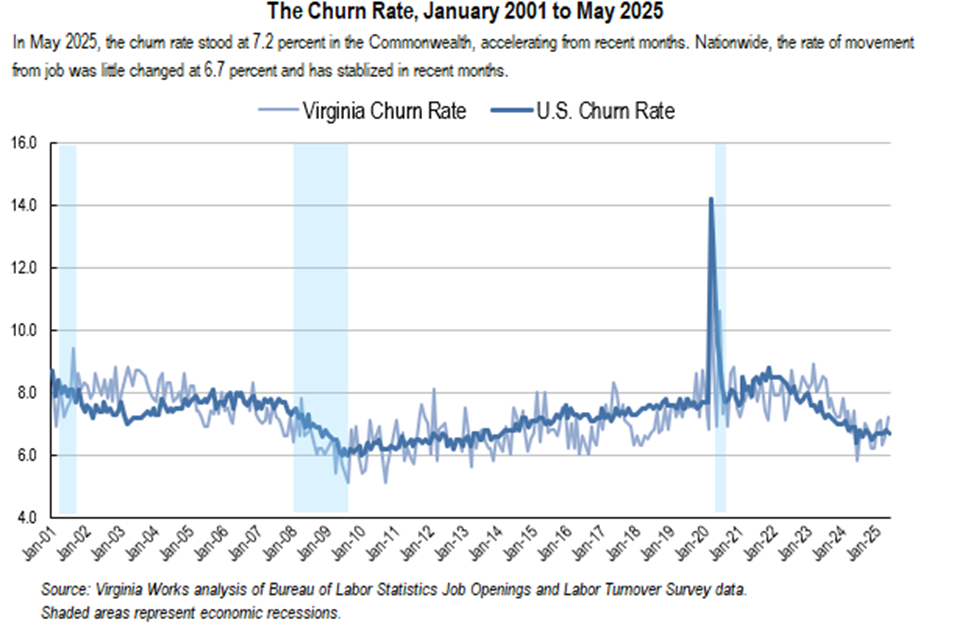
point from April’s revised 6.6 percent figure and was driven by an increase in job hires. It was equivalent to the U.S. churn rate of 6.7 percent, which was little changed over the month.
The number of layoffs and discharges in Virginia was 36,000 in May, a decrease of 31,000 from April’s revised estimate. This was down by 18 percent over the year and 50 percent from May 2020. In May, the number of U.S. layoffs and discharges was little changed at 1.6 million. Layoffs and discharges decreased in finance and insurance (-47,000). The Virginia layoffs and discharges rate fell to 0.8 percent. In May, the rate of layoffs and discharges were little changed at 1.0 percent. Nationwide, the layoffs and discharges rate decreased for establishments with 1 to 9 employees.
On the last business day of May, JOLTS data indicated improved labor market conditions, with increased hires and sharply higher job openings. At the same time, quits rose while layoffs and discharges dropped. This meant that quits comprised two thirds of job separations, which is also considered a sign of labor market strength.
| Job Openings Job openings include all positions that are open on the last business day of the reference month. A job is open only if it meets the following three conditions: (1) A specific position exists and there is work available for that position; the position can be full time or part time, and it can be permanent, short term, or seasonal; (2) the job could start within 30 days, whether or not the employer can find a suitable candidate during that time; and (3) the employer is actively recruiting workers from outside the establishment to fill the position. Excluded are positions open only to internal transfers, promotions or demotions, or recalls from layoffs. Hires Hires include all additions to the payroll during the entire reference month, including newly hired and rehired employees; full-time and part-time employees; permanent, short-term, and seasonal employees; employees who were recalled to a job at the location following a layoff (formal suspension from pay status) lasting more than 7 days; on-call or intermittent employees who returned to work after having been formally separated; workers who were hired and separated during the month; and transfers from other locations. Excluded are transfers or promotions within the reporting location, employees returning from a strike, and employees of temporary help agencies, employee leasing companies, outside contractors, or consultants. Separations Separations include all separations from the payroll during the entire reference month and are reported by type of separation: quits, layoffs and discharges, and other separations. Quits include employees who left voluntarily, except for retirements or transfers to other locations. Layoffs and discharges include involuntary separations initiated by the employer, including layoffs with no intent to rehire; layoffs (formal suspensions from pay status) lasting or expected to last more than 7 days; discharges resulting from mergers, downsizing, or closings; firings or other discharges for cause; terminations of permanent or short-term employees; and terminations of seasonal employees (whether or not they are expected to return the next season). Other separations include retirements, transfers to other locations, separations due to employee disability, and deaths. Excluded are transfers within the same location, employees on strike, and employees of temporary help agencies, employee leasing companies, outside contractors, or consultants. *Excerpted from U.S. Bureau of Labor Statistics, Handbook of Methods, “Job Openings and Labor Turnover Survey: Concepts,” https://www.bls.gov/opub/hom/jlt/concepts.htm. |
Virginia Works plans to release the June 2025 analysis of the BLS Job Openings and Labor Turnover Survey for Virginia on Friday August 15, 2025. The data for all states and the U.S. will be available on the BLS website JOLTS page, at https://www.bls.gov/jlt/. BLS is scheduled to release the June JOLTS data for states on Wednesday August 13, 2025.
Technical note: Effective with the release of May 2025 data, the Job Openings and Labor Turnover Survey (JOLTS) state estimates have been benchmarked and revised to include the annual benchmark revisions to JOLTS national estimates, the Current Employment Statistics (CES) employment estimates, and the Quarterly Census of Employment and Wages (QCEW) data. Seasonally adjusted and not seasonally adjusted data from January 2019 forward are subject to revision. The Bureau of Labor Statistics (BLS) Job Openings and Labor Turnover Survey (JOLTS) produces monthly data on U.S. and regional job openings, hires, quits, layoffs and discharges, and other separations from a sample of approximately 21,000 establishments. For more information on the program’s concepts and methodology, see “Job Openings and Labor Turnover Survey: Handbook of Methods” (Washington, DC: U.S. Bureau of Labor Statistics, July 13, 2020), https://www.bls.gov/opub/hom/jlt/home.htm. For more information on BLS’ state JOLTS estimates, see https://www.bls.gov/jlt/jlt_statedata.htm. Definitions of JOLTS terms*
 PDF of Press Release